
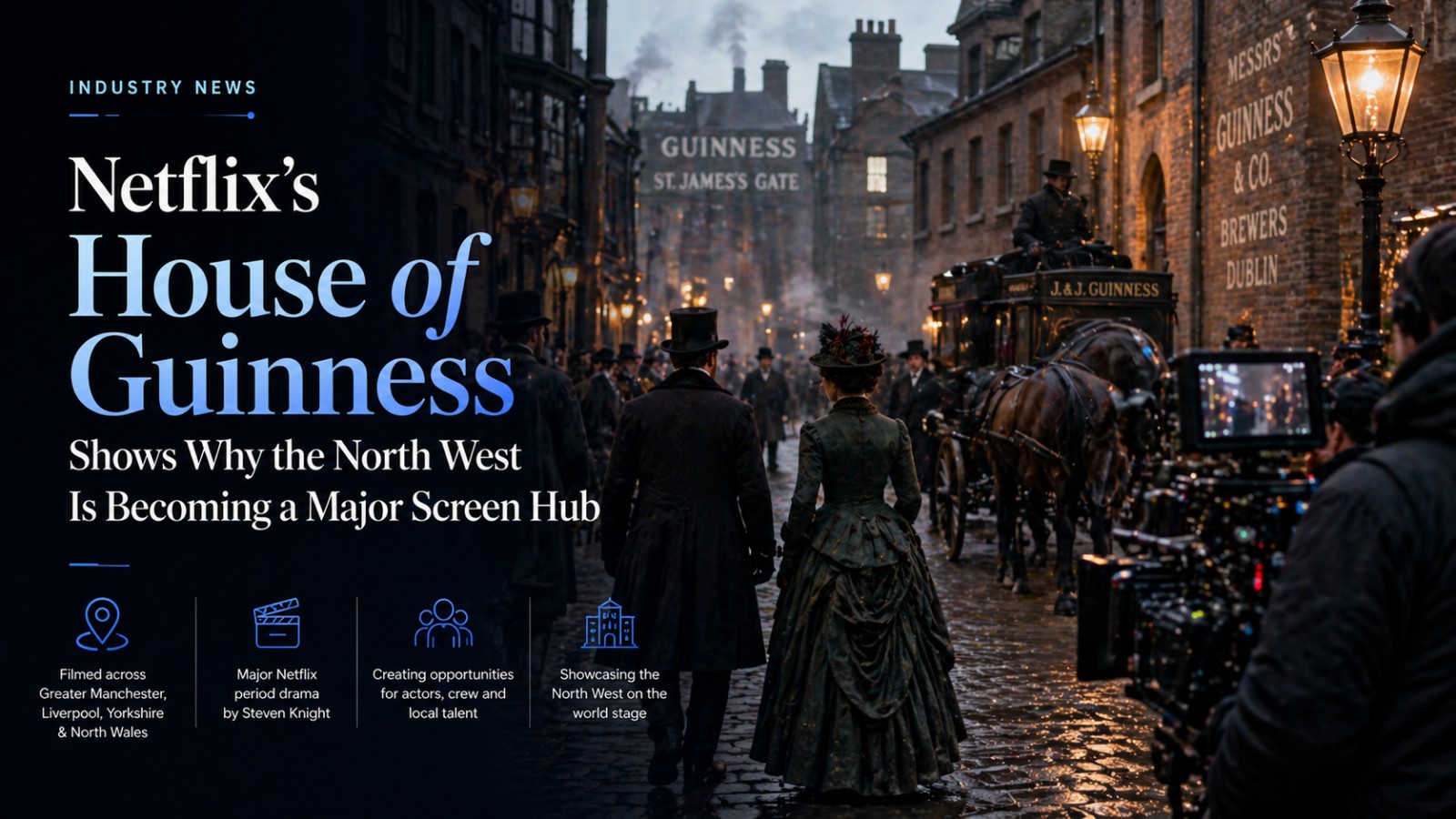
Netflix’s House of Guinness Shows Why the North West Is Becoming a Major Screen Hub
Casring Calls UK
Contributor
Netflix’s House of Guinness Shows Why the North West Is Becoming a Major Screen Hub
From Manchester’s Northern Quarter to Liverpool’s historic docks, Netflix’s period drama House of Guinness is a powerful reminder that the North West is no longer just a backdrop — it is becoming one of the UK’s most valuable screen production regions.
A major Netflix drama with Northern locations at its heart
Netflix’s House of Guinness is an eight-episode historical drama created by Steven Knight, the writer behind Peaky Blinders. The series is set in 1860s Dublin and follows the powerful Guinness family after the death of Sir Benjamin Guinness, with the brewery’s future placed in the hands of his four adult children. Netflix lists the series as an eight-episode drama starring Anthony Boyle, Louis Partridge and Emily Fairn.
Although the story is rooted in Dublin, the production used locations across the North West and beyond to recreate the world of 19th-century Ireland and New York. Filming in England reported that the locations team scouted across Greater Manchester, Yorkshire and Liverpool, with locations ranging from St Philip’s Church in Salford to Broughton Hall Estate in Skipton. Netflix’s own Tudum coverage describes the show as a Steven Knight drama set in the back alleys and stately mansions of Dublin, centred on the Guinness family in the 1860s.
When a major streamer uses Northern locations to build an international period drama, it strengthens the case for more casting, crew, location and production opportunities outside London.
“For Northern actors, productions like House of Guinness are a reminder that major screen work is not only happening in London. It is being built on streets, estates, studios and historic locations across the North West.”
Why Manchester and Liverpool work so well on screen
Period drama needs architecture, texture and atmosphere. Modern glass buildings and freshly paved streets do not always help when a production needs to recreate the 1800s. That is where cities like Manchester and Liverpool become incredibly valuable.
Manchester’s Northern Quarter has long offered red-brick character, narrow streets, warehouses, old facades and industrial atmosphere. Liverpool brings docks, Georgian streets, grand civic buildings, warehouses and historic interiors. Together, these locations can double for multiple cities, periods and worlds.
Reports around House of Guinness highlighted how locations outside Ireland were used because modern Dublin no longer always resembles its 1860s version. People reported that filming took place primarily in England, with Liverpool, Manchester and Yorkshire used for historical architecture, while Manchester’s Northern Quarter stood in for New York’s Bowery.
Manchester
Industrial streets, red-brick architecture, production infrastructure and a strong creative workforce make the city attractive for drama, commercials and streaming productions.
Liverpool
Historic docks, civic buildings and period streets give productions flexible locations that can double for different cities and eras.
The North West is not just “standing in” anymore
One of the most important shifts in UK production is that regional locations are not just being used as convenient substitutes. They are becoming part of the production identity.
A show like House of Guinness may be set in Dublin and New York, but the work of building that world depends on locations, crews, supporting artists, local services, transport, facilities and regional knowledge. Every major production that comes into the region helps strengthen that ecosystem.
For actors, this matters because production clusters create opportunity. The more high-end television and film work takes place in the North West, the more reason there is for talent to be ready locally.
- More productions need local supporting artists and featured performers.
- Period dramas often require a wide range of ages, looks and character types.
- Local accents and regional authenticity can be an advantage.
- Actors with strong self-tapes and updated profiles can respond faster.
- Regional screen work can build credits, confidence and set experience.
What this means for actors and supporting artists
Period dramas can create a broad range of opportunities. Not every role is a lead or named character. Productions need supporting artists, featured background, stand-ins, photo doubles, small speaking roles, crowd scenes, pub scenes, street scenes, servants, workers, officials, family members and public gatherings.
Universal Extras lists House of Guinness among its productions and describes the show as a story of rivalry, duty, ambition and betrayal set against 19th-century Dublin and New York. That kind of world is full of character detail, and it needs people on screen who can help make the period feel lived-in.
Keep your headshots, profile, measurements, location, availability and self-tape setup up to date. Big productions often move quickly, and actors who are ready are easier to consider.
How actors can prepare for opportunities like this
You cannot control when the next major production comes to your area, but you can control whether you are ready when it does.
For a period drama or high-end TV opportunity, actors should make sure they have the basics in place:
- A current, natural headshot that actually looks like you now.
- A clean, easy-to-read acting CV.
- A short showreel or clips if available.
- A reliable self-tape setup with good light and clear sound.
- Accurate location, height, playing age and skills listed on your profile.
- Any dialects, accents, horse riding, dance, music, combat, movement or period skills clearly added.
- Good availability and fast response habits.
For supporting artist work, accuracy is especially important. Productions may need specific measurements for costume, hair length, facial hair, piercings, tattoos, dress sizes, shoe sizes and availability across multiple filming days.
Why Casting Calls UK should cover stories like this
This is exactly the kind of story Casting Calls UK should be talking about. Not as gossip. Not as fake casting hype. But as industry context that helps actors understand where the opportunities are forming.
When a major Netflix production films across the North West, it tells actors something important: the region is active, valuable and visible. Manchester, Liverpool, Yorkshire, Cheshire and North Wales are not outside the industry. They are part of the industry.
Covering these stories helps Casting Calls UK become more than a place to find notices. It becomes a platform that explains the industry, champions regional talent, and helps performers prepare properly for real opportunities.
The bigger picture for Northern talent
House of Guinness is not just another period drama. It is part of a bigger pattern: major productions using Northern locations, crews, services and talent to build stories with international reach.
For actors in the North West, that should be encouraging. The work is not always somewhere else. Sometimes it is being filmed on familiar streets, inside buildings you know, and across regions that have been overlooked for too long.
The message is simple: keep your profile sharp, keep your materials updated, keep developing your craft, and be ready. The next opportunity could be closer than you think.